

New Research Reveals Critical Gap in Canada’s Health Innovation Ecosystem
Source: Dan Wasserman via LinkedIn
A comprehensive analysis of over 100 health innovation pitches has uncovered a previously unrecognized funding gap that may explain why Canadian health technology companies struggle to compete with their American counterparts. This “third valley of death” represents a critical blind spot in Canada’s innovation support system that could be addressed with relatively modest policy adjustments.
This data emerges courtesy of a new fund to aid Canadian medical health innovation companies looking to enter the lucrative US medical market. The US Health Innovation Fund (USHIF) is looking to close the gaps between Canadian and US health funding and act as a support for cross-border development and distribution.
Traditional Understanding: Two Valleys of Death
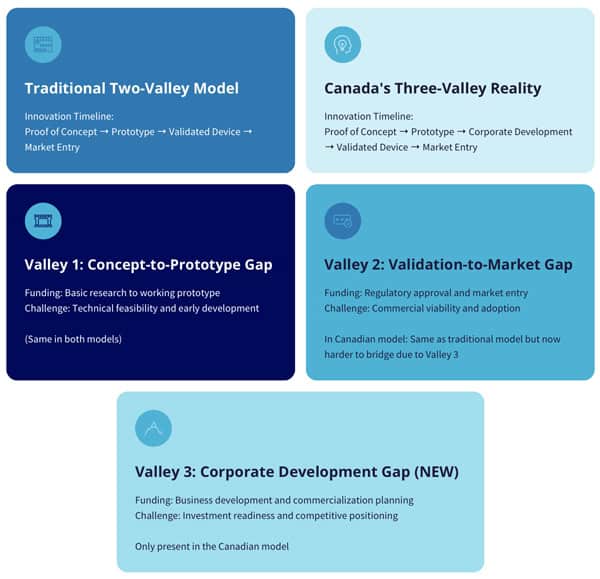
The medical innovation community has long recognized two primary “valleys of death” that startups must navigate:
Valley 1: The transition from proof of concept to early prototype development Valley 2: The gap between validated devices and securing funding for regulatory approval and market entry
These challenges are well-documented and have spawned numerous support programs, accelerators, and funding mechanisms across North America.
The Discovery: Canada’s Hidden Third Valley
Recent analysis reveals that Canadian health innovators face an additional, previously unidentified challenge that sits between the traditional two valleys. This “Third Valley” stems from insufficient early-stage funding specifically allocated to corporate development activities.
The Corporate Development Gap
While Canadian and American health innovators typically raise comparable amounts in pre-Series A funding, a critical difference emerges in how these funds are allocated:
- United States: Nearly 33% of non-dilutive funding (such as SBIR grants) must be dedicated to commercialization activities, with detailed “Commercialization Plans” required for funding consideration
- Canada: Effectively zero percent of early funding is specifically allocated to corporate development
This disparity creates a structural disadvantage for Canadian companies as they progress toward Series A funding rounds, where investors expect sophisticated corporate development capabilities.
Impact on Investment Readiness
The analysis of 100+ health innovation pitches to angel investor groups revealed consistent patterns:
- Canadian companies typically request funding amounts within tight ranges
- These requests are generally lower than comparable US firms at similar development stages
- A modest increase of less than 10% would adequately address the corporate development shortfall
- This adjustment would create more comprehensive “Use of Funds” presentations that resonate with potential investors
The Sweet Spot Solution
The transition stage from Seed to Series A funding represents the optimal intervention point for addressing this gap. Companies at this stage have:
- Validated their core technology
- Demonstrated initial market traction
- Reached sufficient maturity to benefit from enhanced corporate development
However, to compete effectively with US companies, Canadian innovators must ensure their corporate development profiles meet or exceed international standards.
Implications for the Canadian Innovation Ecosystem
This research suggests several critical implications:
For Policymakers: Current non-dilutive funding programs may need restructuring to include mandatory corporate development components, similar to US SBIR requirements.
For Investors: Understanding this gap helps explain why Canadian health innovation companies may appear less investment-ready compared to US counterparts, despite having comparable technical achievements.
For Entrepreneurs: Recognizing and proactively addressing corporate development needs could significantly improve funding success rates and competitive positioning.
The Path Forward
Addressing Canada’s Third Valley of Death doesn’t require massive new funding programs. Instead, it calls for:
- Enhanced funding requirements that mandate corporate development activities
- Investor education about the structural differences between Canadian and US innovation ecosystems
- Strategic planning support to help companies develop competitive corporate development capabilities
Conclusion
The identification of Canada’s Third Valley of Death provides a concrete, addressable explanation for the competitive disadvantage facing Canadian health innovators. By recognizing and systematically addressing the corporate development funding gap, Canada could significantly strengthen its position in the global health innovation landscape.
The solution requires neither revolutionary changes nor massive new investments—just a strategic reallocation of existing resources and a commitment to matching the corporate development standards that have proven successful in other markets.