
Nusano will bring a massive new radioisotope facility in Salt Lake City online by the end of the year, establishing a supply of starting materials for the next generation of radiopharmaceuticals.
A few years ago, Big Pharma began rushing into radiopharma. But it turns out, no one considered whether the existing manufacturing infrastructure could handle the load of new radioligand therapies that would one day need to reach patients—and quickly.
Enter Nusano, the Salt Lake City–based physics company developing a brand-new radioisotope facility.
“Everybody wants to bake a cake. But what if you go to the pantry to bake the cake and there’s only two cups of flour?” Eric Dorman, accelerator operations manager at the SLC site, said during a recent tour of the 190,000-square foot facility. “We’re bringing a giant flour mill online.”
Therapies like Novartis’ Pluvicto for prostate cancer and Lutathera for gastroenteropancreatic neuroendocrine tumors (GEP-NETs) are just the beginning, Dorman explained. The hope is that as companies press into the space, they may crack other cancers that are vulnerable to this next-generation radiotherapy.
Nusano’s radioisotope factory is expected to be online by the end of the year to start making isotopes to be used in early research but eventually expects to produce commercial therapies after they’ve been through the FDA usual process. All told, the facility will have 15 to 30 times the production power of existing cyclotron technology and be able to manufacture 40 different radioisotopes, some of which will form the payload of future radiotherapies. The company will be able to produce more particles than any existing facility, Dorman said.
But first, they have to build it. BioSpace was invited inside the Nusano facility in April to tour the ongoing construction. The employees—self-proclaimed nuclear nerds with a long history of research—were buzzing with excitement and purpose.
The secret sauce
Inside a white-halled building plastered with caution signs, the production facility thrummed with quiet activity. “We’re slowly putting the Legos together,” Dorman said as he gave me the tour last month.
In the control room, a quiet group of nuclear engineers watched as a test ran on a bank of computer screens. Our group waited for the all clear to proceed into the room.
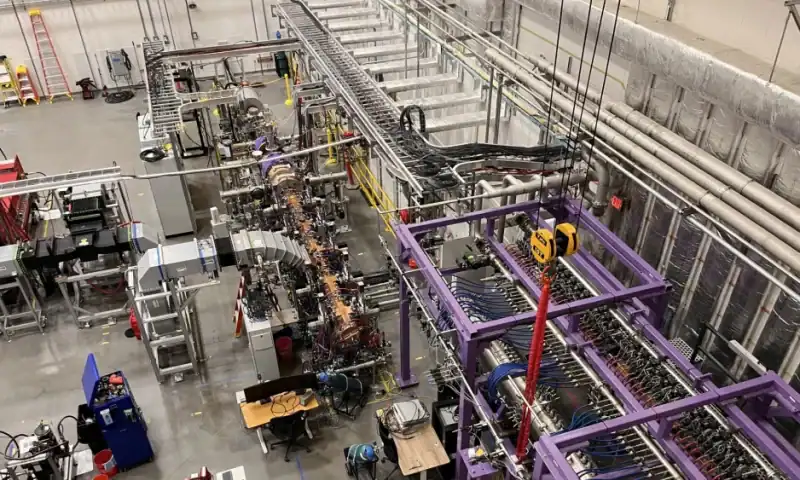
A tangle of what looked like HVAC equipment, ladder structures, electrical wires and waterlines filled the production room.
Dorman pointed out what he called Nusano’s “secret sauce”: the particle beam technology, called the Ion Source. It’s housed in an unassuming grey canister, much like a power pole transformer. This is where the ions—or “surfers,” as Dorman called them—are created to start the whole process.
After creation, the ions are collected into a beam and stabilized in the particle accelerator with high-powered magnets. The beam begins its journey at about one-sixth the speed of light as it travels through the 70-foot linear accelerator, which directs the isotopes via a series of magnets along the production facility.
While testing proceeds, construction is active throughout the facility. Dorman apologized that he couldn’t take us directly along the path of the linear accelerator because the floors were being done that day. Instead, the tour headed outside to take the long way around, eventually arriving at what Dorman referred to as the LinAcc Hall, housed within concrete multiple feet thick.
“For the longest time, you’d come and it looked like we had built a concrete box,” Dorman said, explaining that the facility is designed to withstand earthquakes.
Inside was similarly unassuming. While the equipment hadn’t been fully installed yet, a massive concrete room was being filled with metal tracks to support the linear accelerator and the magnets that will direct the beam coming from the Ion Source. All that infrastructure directs the beam to one of 12 tracks, where at the end a target is placed to create and collect the resulting radioisotopes.
The beam can be split into different tracks, meaning up to 12 different radioisotopes can be created at once. The facility can run one or all 12, according to the order that day, Dorman explained.
The LinnAcc Hall at Nusano’s radioisotope production facility in Salt Lake City. Each track will route the beam into one of 12 windows to meet a target, creating the isotopes.