
Researchers at Linköping University show how two important cancer-related proteins can be prevented from collaborating with each other. The discovery shows the way toward future medications to combat, for example, neuroblastoma in children. Their study has been published in the journal Nature Communications.
Why targeting MYC is so difficult
“Today we can cure many cases of childhood cancer that were incurable ten years ago. But there’s still an important group of childhood tumors that evade cure. Researchers in this field are looking for ways to affect cancer cells when nothing else works,” says Maria Sunnerhagen, professor of structural biology at Linköping University.
Her research group has spent several years researching a protein family, called MYC proteins, that plays important roles in the development of many types of cancer. In the current study, they focused on N-MYC. N stands for neuroblastoma, the cancer form in which the protein was first discovered. Neuroblastoma is an unusual tumor disease of the nervous system that almost exclusively affects children, mainly younger than 2 years old. About half of the children have high-risk tumors with a lower chance of being cured. N-MYC is linked to poorer prognosis in neuroblastoma.
Medications that inhibit MYC would have the potential to be an important advance in cancer treatment. These have, however, proven so difficult to develop that MYC proteins have often been referred to as inherently “undruggable.”
“Classic medical drug development is based on the fact that there is a pocket on the protein that you block with a molecule that binds there, much like Lego bricks that fit together. But MYC keeps changing shape,” says Sunnerhagen.
Most proteins have a definite three-dimensional structure that usually contributes to their function and how they interact with other proteins. MYC is different and does not really have a fixed three-dimensional structure. The protein is flexible and constantly changes shape, which poses a challenge to researchers seeking to understand how MYC proteins work.
Also, MYC proteins are involved in the processes necessary for healthy cells to grow and divide. To prevent all cells in the body being harmed, it is important that a drug inhibits only the MYC function that is the problem in cancer cells, and nothing else. In other words, it takes a molecule that specifically affects a certain interaction between N-MYC and another protein.
Pinpointing Aurora A’s crucial interaction
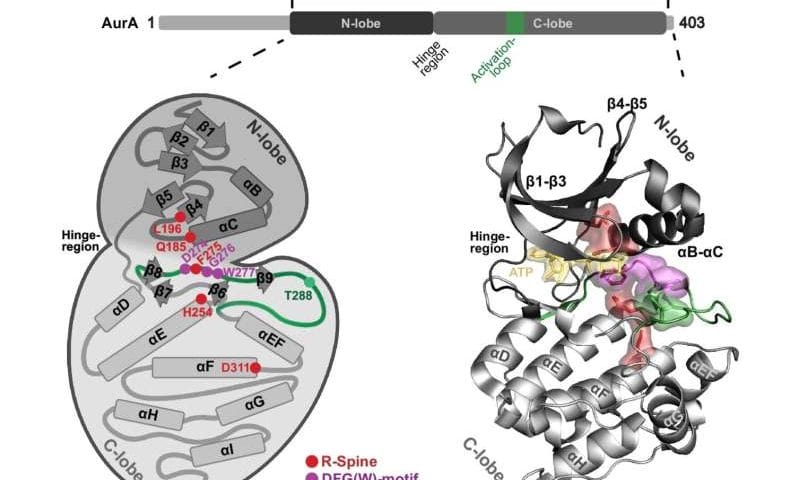
In the current study, the researchers focused on the protein Aurora A, which also has a role in neuroblastoma and many other tumor forms. Preventing these proteins from interacting with each other has been suggested as a way to treat childhood tumors.
“To stop an interaction, you need to know where it’s happening. Despite the fact that N-MYC constantly changes shape, we now know where the two proteins anchor to each other. This provided clues as to what the medication should look like. We’ve also found a small molecule that manages to break apart the proteins, which lays a good foundation for future clinical trials,” says Johanna Hultman, Ph.D. student in the same research group at Linköping University.
The elusive N-MYC protein was a worthy opponent and presented a real challenge to the researchers characterizing it. To succeed, researchers at the Department of Physics, Chemistry and Biology at Linköping University collaborated with Professor Linda Penn’s research group at the University of Toronto in Canada on the interdisciplinary study. They used many different methods, such as nuclear magnetic resonance (NMR), AI calculations and molecular analyses of the function of proteins.
“We’re very pleased that in this particular case, which is relevant to childhood cancer, we have gained some more understanding about how these proteins find and bind to each other. We can now hand over the baton to other researchers working in clinical cell biology and pharmacology to explore whether it’s possible to take this further to drug development,” says Sunnerhagen.