
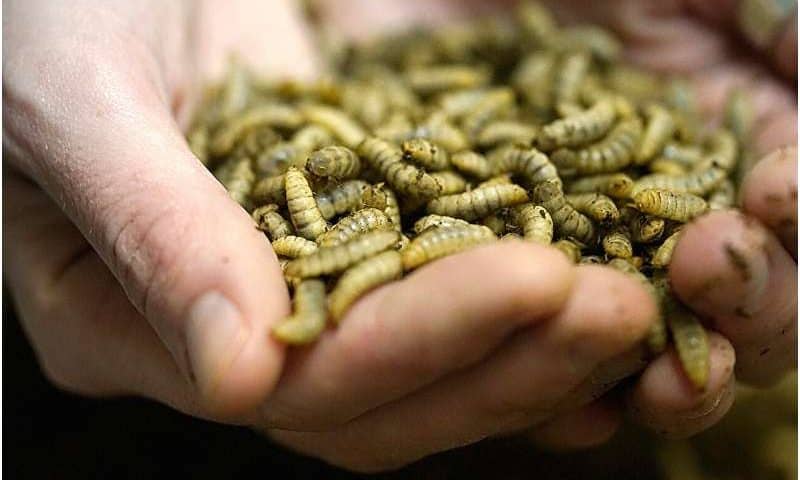
Texas A&M AgriLife Research scientists have developed a patented breakthrough system that marks a major step forward in insect biomanufacturing, waste reduction and sustainable protein production.
The new “Black Soldier Fly Billet” was developed in the lab of Jeffery Tomberlin, Ph.D., a Texas A&M AgriLife Research Fellow, professor in the Texas A&M Department of Entomology and director of the Center for Insect Biomanufacturing and Innovation. It represents the first reliable method for long-term, room-temperature storage of young black soldier fly larvae.
Tomberlin called the innovation a “game changer” for the burgeoning industry.
“For decades, one of the greatest challenges in this industry has been production stability,” Tomberlin said. “Producers have never had a dependable bank of young larvae that could be stored longer than a few days without requiring cutting-edge technology. With the billet, they finally do. You can store these units for weeks, even months, and pull them off the shelf the moment you need them.”
Technology brings reliability to insect biomanufacturing
Each billet is a pint-sized container engineered with layers of fermented feed, newborn larvae and a dry food “blanket,” sealed with a breathable lid that maintains consistent moisture and temperature. The system preserves larval viability far beyond the two-to-four-day window typical under conventional rearing methods.
Once opened and emptied onto organic waste, Tomberlin said each unit can generate up to more than 3 pounds of harvestable larvae in as little as seven to 10 days.
“The billet packages the scientific process,” Tomberlin said. “It’s the Betty Crocker of the black soldier fly world. You just add the larvae from the billet to the waste and let the biology do the work.”
The technology also accelerates production timelines by 20–30%, reducing both time and space needs—critical factors that directly affect cost and revenue. Tomberlin said this efficiency unlocks a new level of scalability for insect biomanufacturing.
“Whether you’re a backyard composter or an industrial facility needing 10,000 units a day, this system works,” he said. “You can even imagine a hub-and-spoke model, where a central nursery produces billets that ship anywhere in the country, any time of year. No cryogenics. No specialized equipment. Just room-temperature storage.”
Black Soldier Fly Billet could reshape industry
The billet addresses another major bottleneck: the mismatch between waste availability and larval production, Tomberlin said.
“If your eggs hatch and you’re not ready to use them, they die in a few days,” Tomberlin said. “If waste arrives and you don’t have larvae, the waste piles up. The billet solves both problems. It’s a reserve supply you can rely on.”
The technology aligns with Texas A&M’s leadership in circular-economy innovation and supports the Center for Insect Biomanufacturing and Innovation’s mission to convert insects into scalable, market-ready tools for waste reduction, sustainable protein production and other products including frass, a rich, organic fertilizer from larvae feces, shed skins and leftover food.
Tomberlin said the team is now seeking an industrial partner to license and commercialize the system.
“This has not been developed anywhere else in the world,” he said. “It’s coming from Texas A&M, and it has the potential to reshape the entire industry.”