
Bipolar disorder is a mental health condition characterized by extreme mood swings, with alternating periods of depression and manic episodes. Past research suggests that bipolar disorder has a strong genetic component and is among the most heritable psychiatric disorders.
To better understand the genetic factors that increase the risk of developing this mental health disorder, neuroscientists and geneticists have carried out various genome-wide association studies (GWAS). These are essentially studies aimed at identifying specific regions of the human genome that are linked with an increased risk of having bipolar disorder, also referred to as bipolar risk loci.
While earlier works have identified many of these regions, causal single nucleotide polymorphisms (SNPs) for the disorder are largely unknown. These are essentially genetic variants that primarily contribute to bipolar disorder risk, as opposed to just being mere markers of it.
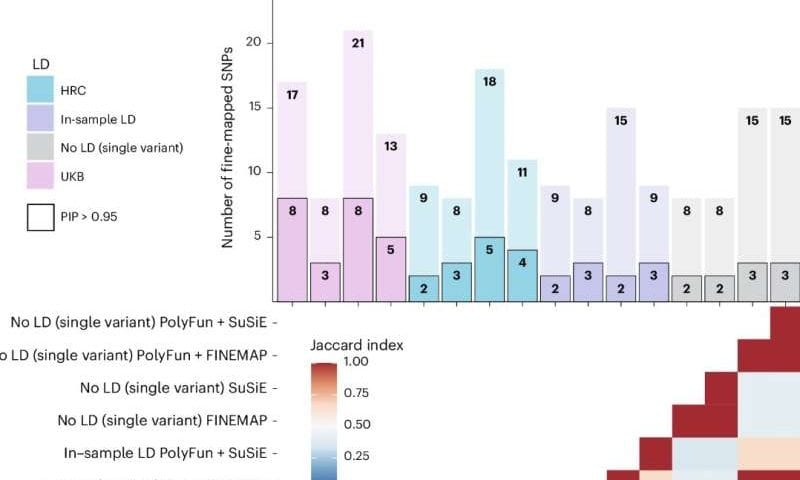
Researchers at the Icahn School of Medicine at Mount Sinai and other institutes recently carried out a new study aimed at pinpointing SNPs that directly contribute to an increased risk of developing the disorder. Their findings, published in Nature Neuroscience, were obtained by analyzing large genetic datasets using various statistical and specifically, “fine-mapping” techniques.
“This work emerged from a longstanding effort to improve our understanding of the genetic architecture of bipolar disorder,” Maria Koromina, first author of the paper, told Medical Xpress. “While prior genome-wide association studies (GWAS) identified 64 genomic regions linked to bipolar disorder, the causal variants and genes often remain unknown.”
The primary objective of this recent study was to pinpoint the likely causal SNPs contributing to an increased risk of developing bipolar disorder, as well as the genes they are linked to. The researchers specifically analyzed data gathered by the Psychiatric Genomics Consortium (PGC), a large-scale international collaboration established in 2007 that collects genetic and medical data from thousands of people of European ancestry diagnosed with mental health disorders, as well as individuals with no mental health conditions.
“To investigate the genetic variants contributing to bipolar disorder risk, we applied fine-mapping methods to GWAS data from approximately 41,917 BD cases and 371,549 controls of European ancestry,” explained Koromina.
“Then, we integrated these findings with epigenomic data specific to brain cell types and a variety of quantitative trait loci (QTLs), in order to understand how genetic variants influence gene expression, splicing or methylation. This combined approach allowed us to prioritize genetic variants that are more likely to contribute to bipolar disorder risk and to map them to candidate genes with higher confidence.”
Using their fine-mapping pipeline, Koromina and her colleagues were able to narrow down the many genomic regions identified in previous studies, ultimately uncovering 17 SNPs that are most likely to be linked with a greater risk of developing the disorder. In addition, they connected these SNPs to specific genes known to regulate development of the brain and communication between neurons.
“We identified several likely causal variants and linked them to genes with known roles in neurodevelopment and synaptic signaling, including SCN2A, TRANK1, CACNA1B, THSD7A, and FURIN,” said Koromina.
“Notably, three genes also show high expression in gut cells, supporting a genetic connection between the microbiota–gut–brain axis and BD. We also demonstrated that integrating fine-mapping effects sizes into polygenic risk scores (PRS) improved their predictive accuracy, specifically across diverse ancestral groups.”
The findings gathered by Koromina and her colleagues further improve the understanding of bipolar disorder and its genetic underpinnings. The researchers hope that their work will inspire further studies focusing on the genetic variants they uncovered. In the future, their efforts could also contribute to the development of therapeutic interventions that account for each patient’s unique genetic profile.
“Future research could focus on functionally validating the top-prioritized genes and variants using models such as CRISPR-edited neuronal cells and brain organoids,” added Koromina. “These experiments will help determine how these variants influence gene regulation and neural function. Ultimately, our goal is to translate these genetic insights into better tools for tailored therapeutic strategies.”