
Most folks know intermittent fasting helps with weight loss, usually by limiting your daily eating window or cutting calories a couple of times a week. But does your age change how well this works for you—and might there be some hidden dangers?
Intermittent fasting, such as time-restricted eating or the 5:2 diet, is very popular. With this eating method, you will consume your food within an eight-hour period and fast the rest. With the 5:2 diet, you eat normally five days of the week and drastically cut your calories on the other two days. Many studies show that these techniques are effective, but whether the effectiveness is distributed equally across the population, and especially among people of different ages, is unknown.
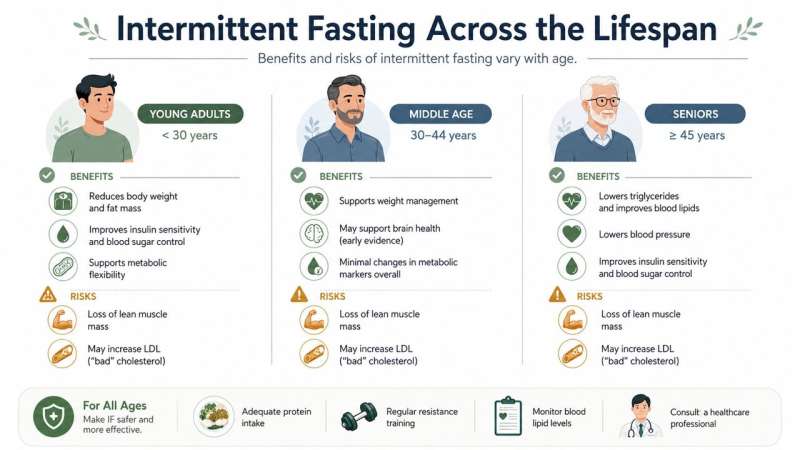
A recent comprehensive analysis of 28 clinical trials involving over 1,800 adults shows that intermittent fasting (IF) cuts down body weight and BMI, irrespective of age and sex. However, this deep dive into the data uncovers a surprising truth: the metabolic journey on IF is far from uniform.
A 20-something experiences a distinctly different set of physiological adaptations from those of a 60-year-old. This age-dependent response challenges the traditional one-size-fits-all approach to fasting, revealing that while weight loss is universal, the underlying health impacts are profoundly influenced by where you are in life.
When fat loss comes at the price of muscle
Health isn’t just about the number on the scale. Alarmingly, the study, published in the journal Nutrients, found that in many groups a large share of pounds lost was lean mass, not just fat.
In fact, weight loss often carries a known penalty: typically, 20–30% of the dropped weight is muscle. One fasting trial reported 65% of the weight loss came from lean tissue. Without careful planning, those who fast can end up thinner and weaker. That might be especially dangerous for older adults, who naturally lose muscle each year.
It is essential to prevent muscle loss. Increasing research indicates that strength training and a higher intake of protein can replace the fasting lean-mass drains. For instance, scientists found that exercise paired with a time-restricted eating plan preserved muscle: fasters who also did aerobic or resistance workouts lost fat but preserved their lean tissue.
A study of alternate-day fasting in conjunction with exercise resulted in a loss of 6 kg of body weight (5 kg fat, 0 kg muscle) and even dropped LDL cholesterol by 12%. The takeaway: fast with weights. Experts now recommend that anyone on an IF diet should boost protein intake and do resistance training to help the muscles hang on during the calorie cuts.
A surprise: Rising LDL
Even as many health markers improve on IF, one finding raised eyebrows: bad cholesterol rose on average, across age groups. Prior analyses had reported that intermittent fasting typically lowers LDL cholesterol, yet this review saw just the opposite.
After fasting, participants’ LDL-C tended to creep up in most age brackets. This was enough to set off alarm bells. As one of the authors warns, “the generalized risk of LDL-C elevation across age strata dictates a mandate for vigilant lipid monitoring.” Therefore, even if your blood sugar and triglycerides improve, regular cholesterol tests are crucial for those on fasting diets to ensure heart health.
Fasting with safeguards: protein, weights and checks
It should be noted that this is not a general condemnation of fasting. According to the authors, IF is “an effective weight-management tool,” not a cure for all. It’s all about customizing. This involves, in practice, fasting and muscle-friendly activities. Fueling up on lots of high-quality protein combined with gym activity—especially as we age—can help preserve strength.
Harvard experts, for example, found that exercise added to a feeding-window diet prevented muscle loss found in fasters without exercise. Meanwhile, check your lipids: getting screened for cholesterol is a good idea while fasting if you make it a habit.
What’s the conclusion? Indeed, intermittent fasting will help lose weight for the young and old. Age plays a role in side effects. According to one of the study’s authors, “IF is an effective weight-management tool but elicits distinct, age-specific metabolic trajectories.”
In your 20s, then, fasting is metabolically different from fasting in your 60s. In the future, research will determine ways to preserve muscle and manage LDL spikes. Until that time, eat smart: treat interventional fasting like a tool in a toolbox of healthy habits, not a cure-all.