
What if a common herb found in the kitchen could help farmers grow healthier crops? As the global population grows and agriculture faces increasing environmental challenges, scientists are searching for innovative ways to improve crop productivity while reducing reliance on chemical inputs.
Nanotechnology has emerged as a potential solution. We believe that environmentally friendly nanomaterials derived from natural sources can become valuable tools for sustainable crop production. Our study demonstrates that even a simple plant, such as basil, can inspire innovative solutions for future agriculture.
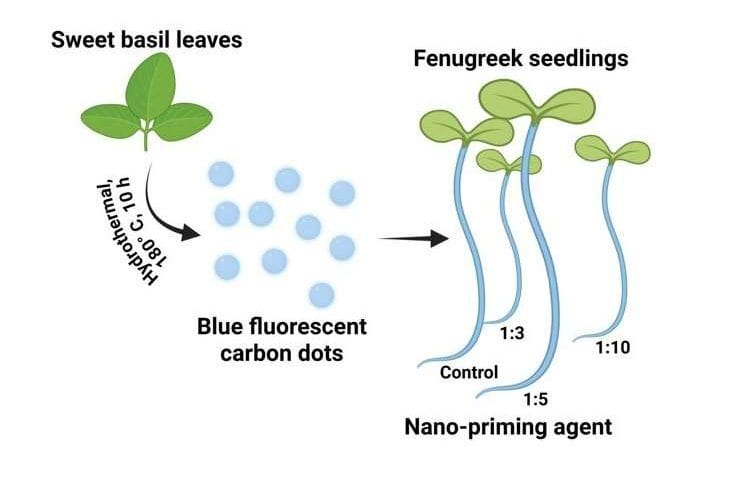
Researchers at the National School of Continuing Education (ENES-León), National Autonomous University of Mexico (UNAM) and the Autonomous University of Queretaro (UAQ) have developed tiny particles known as carbon dots from sweet basil leaves, which are inexpensive to produce, biodegradable, and can interact with plants in ways that enhance nutrient uptake, photosynthesis, and overall growth. More importantly, they may serve as environmentally friendly growth stimulants for plants.
From basil leaves to nano-dots
Scientists transformed basil leaves into carbon dots through hydrothermal treatment, which are 5 to 8 nanometers in diameter with high colloidal stability. Unlike many conventional agricultural additives, these carbon dots are derived from natural plant materials, making them biodegradable and potentially safer for the environment.
To test their agricultural potential, researchers treated fenugreek seeds, a crop widely used as a food ingredient and medicinal plant, with different concentrations of carbon dots.
The findings are published in the journal Materials Letters.
The results were encouraging and promising. At an optimal concentration, the seedlings exposed to dots develop longer roots, taller shoots, and greater biomass than untreated. Also, the uptake of dots were observed and evidenced by fluorescence under ultraviolet light.
A step toward sustainable farming
This study considered a fenugreek seedling as a model plant for preliminary studies, but the findings open the door to exploring carbon dots for other crops too.
In future studies, we will investigate how nanodots affect plant growth under field conditions like stress, such as drought or soil quality. This work also revealed an important lesson, “more is not always better,” by highlighting the need for careful optimization before application.
This study demonstrates that something as ordinary as basil leaves can become a source of advanced nanomaterials with the potential to support the future of agriculture. By combining green chemistry and plant science, researchers have uncovered new ways to grow more food while protecting the environment.
Finally, Dr. Ravichandran Manisekaran stated that this research highlights how green nanotechnology can bridge nature and innovation, transforming everyday plant materials into advanced tools that may contribute to more sustainable food production.
This story is part of Science X Dialog, where researchers can report findings from their published research articles. Visit this page for information about Science X Dialog and how to participate.