
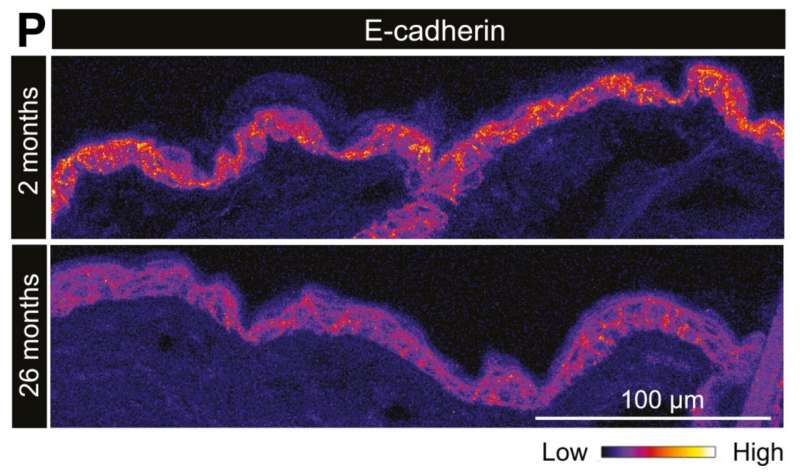
Scientists have developed a powerful new technique that allows them to observe how individual cells manufacture proteins during aging, offering an unprecedented glimpse into the hidden molecular activity of stem cells in living tissue. As a result of the research, conducted at the Institute for Regenerative Medicine in Switzerland, scientists were able to observe aging unfold inside individual epidermal stem cells.
What scientists saw was the intricate choreography within stem cells and how those molecular dance steps slow and change with age. The team of Swiss scientists has concluded that the process of aging reshapes how skin stem cells manufacture proteins. The findings are published in the journal Molecular Cell.
Protein production impacted
The study revealed that aging epidermal stem cells undergo distinct shifts in their protein-production capabilities, changes that could help explain declining regenerative capacity of these cells in older tissue.
Using an advanced form of single-cell ribosome profiling in an animal model, investigators were able to map the “translational landscapes” of aging skin—essentially tracking how stem cells control protein production over time. Translational landscapes refer to the overall pattern of protein production.
Mechanistically, ribosome profiling allows scientists to determine which messenger RNAs are actively being translated into proteins inside cells at a given moment. The profiling technique not only allowed researchers to eavesdrop on living cells but led to the discovery that aging stem cells in the skin become reprogrammed.
“Stem cells are characterized by two features: their ability to self-renew throughout life and to differentiate into other cell types,” wrote Dr. Clara Duré, lead author of the new research, who—along with a team of investigators—has opened a new window of understanding into stem cells throughout various stages of life.
Stem cells are blank slates
Because stem cells are essentially blank slates capable of morphing into any cell type, their biological role and fate differ significantly from other cell types. By tracking them through stages of life, it’s possible to see how they impact processes such as inflammation and immunity, the team found.
Paradoxically, even during youth, stem cells are not high-energy cells that keep their ribosomes busy with the production of proteins. Instead, these workbenches in stem cells where proteins are constructed exist as relatively quiescent structures.
“Somatic stem cells are characterized by their low overall protein-synthesis rates, a feature implicated in driving their stemness,” Duré continued, noting that the term “stemness,” refers to the cells’ capacities for self-renewal and remaining unspecialized until needed.
Both of these functions are closely linked to their precise regulation of gene expression. Somatic stem cells exhibit a unique signature marked by high ribosome biogenesis and a low protein synthesis rate.
Aging reshapes translational capacity
Yet, exactly how aging reshapes the translational landscape of stem cells had remained poorly understood until the new research helped illuminate what was occurring within stem cells themselves.
The ribosome profiling technique allowed the Zurich-based team to determine which messenger RNAs were being actively translated into proteins inside cells at any given moment, and across different stages of aging in the mouse model, which was used in the study.
“Somatic stem cells exhibit a unique signature marked by high ribosome biogenesis and low protein synthesis rates, a feature that is implicated in independently driving their stemness, regardless of cellular proliferation, cell cycle, or total mRNA content,” Duré and colleagues noted in the study.
Several takeaways from the research suggest that the potent new technique for studying stem cells in living tissue could eventually permit research on aging tissue in unprecedented detail, illuminating why these cells lose regenerative power over time.
“Our study focuses on the epidermis. This tissue is highly heterogeneous, including epidermal stem cells, differentiated keratinocytes, hair follicle cells, and resident immune cells such as macrophages, dendritic cells, and T cells,” Duré concluded. “We note, however, that extending the single-cell ribosome profiling protocol to additional tissues may require further optimization.”