
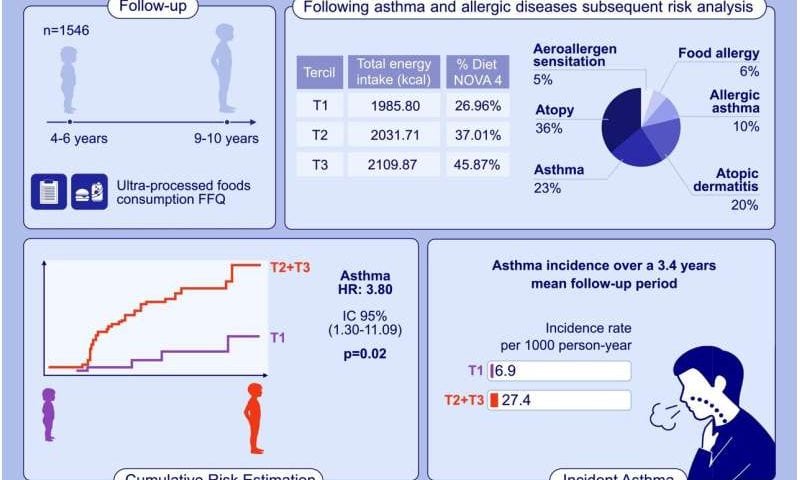
Children who get more than 30% of their daily energy from ultra-processed foods (UPFs), such as soda drinks, packaged snacks, and sweetened breakfast cereals, have a nearly fourfold risk of developing asthma in their early school years.
The finding comes from a new study published in the journal Allergy that followed nearly 700 Spanish children for an average of 3.4 years as part of the SENDO (Seguimiento del Niño para un Desarrollo Óptimo) project.
The diet-asthma connection
Asthma is a common, long-term condition that affects breathing and often runs in families. While genetics are known to play a role, environment and lifestyle factors are also to blame. In this study, researchers wanted to know whether certain parts of our modern diet, specifically ultra-processed foods, were associated with the later development of asthma and other allergic diseases.
They followed 691 children who were 4 or 5 years old when the study started. Parents reported what their children ate by completing a detailed questionnaire, and the team categorized the foods using the NOVA system. This is a framework that classifies foods by processing levels rather than nutrient content.
Parents also updated the researchers each year on whether their children had been diagnosed with asthma or allergies. To ensure accuracy, the team took into account numerous factors that might skew the results, such as the child’s weight and how much time they spent in front of screens.
A clear pattern emerges
The results showed a strong link between ultra-processed foods and asthma. “Higher UPF consumption may be associated with an increased risk of developing asthma in school-age children,” commented the team in their paper.
Beyond the nearly fourfold increase in asthma risk compared to children with the lowest intake of UPFs, the study found that the quantity of processed foods mattered. As the percentage of processed food in a child’s diet went up, the likelihood of an asthma diagnosis also appeared to increase.
However, no such link was shown between ultra-processed foods and other allergic conditions. The study authors suggest that this may be because UPFs are irritating the lungs through a type of inflammation not related to an allergic reaction.
Given the link between diet and asthma suggested in the study, the scientists issued a call to action. “These findings highlight the need for public health policies aimed at limiting processed food consumption in children’s diets as a preventive strategy.”