
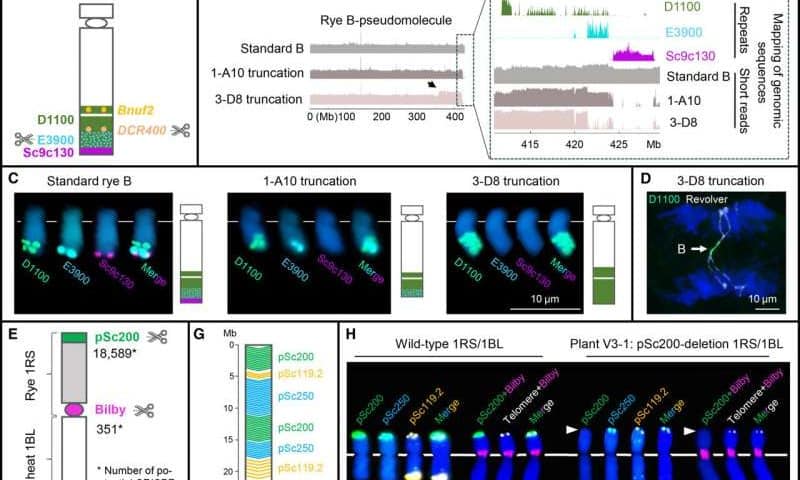
For the first time, a research team at the Leibniz Institute of Plant Genetics and Crop Plant Research (IPK) has succeeded in reducing the size of, or even completely removing, chromosomes in plants with large genomes, such as wheat. They achieved this by using the CRISPR/Cas gene-editing tool to target highly repetitive sections of DNA. The results of the study, published today in the journal Plant Communications, could significantly accelerate breeding processes.
While the targeted manipulation of entire chromosomes is well established in model organisms such as Arabidopsis thaliana, it has posed a significant challenge in crops with large genomes, such as wheat. The IPK research team has now set out to determine whether highly repetitive DNA sequences known as satellite DNA are suitable targets for the CRISPR gene-editing system. The idea was that cutting many of these identical sequences simultaneously could affect the entire chromosome. The team introduced CRISPR components into the plants using a virus-based system. This approach bypasses lengthy traditional transformation processes and enables highly efficient chromosomal modifications.
“In our study, we were actually able to demonstrate for the first time that chromosomes can be efficiently reduced in size by making targeted cuts in satellite DNA,” says Dr. Jianyong Chen, the study’s first author. This is a significant breakthrough, as such changes had previously only occurred by chance. You can think of it like a rope. If you cut a rope in several places at once, it becomes unstable and eventually snaps. The same thing happens to chromosomes when many cuts are made simultaneously.
In some cases, the method resulted in the loss of entire chromosomes. “If too many breaks occur, the cell can no longer repair the chromosome efficiently—it is lost entirely,” explains Prof. Dr. Andreas Houben, head of the IPK’s research group “Chromosome Structure and Function.”
Faulty repair processes can also create new forms of chromosomes, called isochromosomes. “These changes can generate new genetic variants, opening pathways for breeding resistant wheat and other crops,” explains Prof. Dr. Houben. This innovation potential should inspire optimism about future crop improvements.
The study shows that plant genomes can be modified with unprecedented precision. Notably, satellite DNA, once considered “genetic ballast,” is now an effective target for modern breeding tools. “This approach enables efficient manipulation of chromosomes, paving the way for transferring valuable traits from wild relatives into cultivated wheat,” say the IPK scientists, encouraging a sense of empowerment in future crop development.