
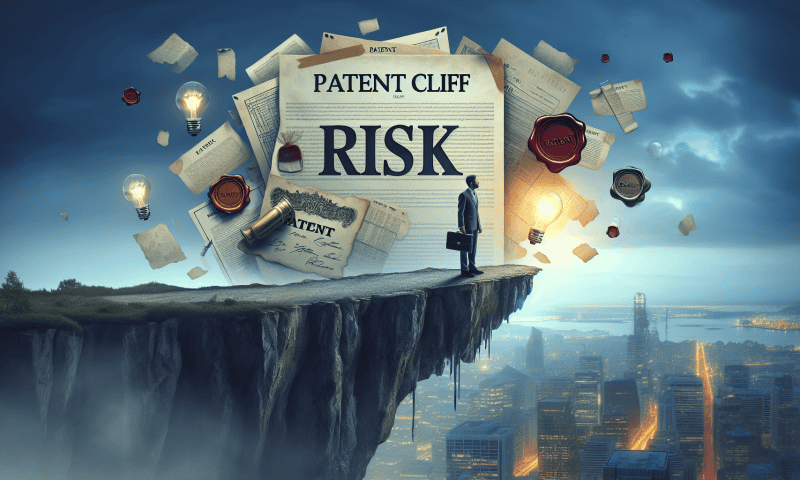
The pharmaceutical industry faces an existential challenge that’s reshaping how major companies operate, invest, and plan for the future. As blockbuster drugs lose patent protection, pharmaceutical giants are confronting massive revenue declines that can wipe out billions in annual sales overnight. This patent cliff risk has evolved from a periodic concern into a persistent threat that demands immediate strategic attention from industry leaders.
The stakes couldn’t be higher. When a drug’s patent expires, generic competitors can enter the market within months, often capturing 80-90% of market share while original prices plummet by similar margins. For companies that have built their financial foundations on a handful of high-performing medications, this transition represents nothing short of corporate transformation.
The Scale of Patent Cliff Risk Facing Major Pharmaceutical Companies
Patent cliff risk extends far beyond theoretical concerns, manifesting as tangible financial threats that directly impact shareholder value and operational sustainability. Recent industry analyses reveal that approximately $200 billion in annual pharmaceutical revenues face patent expiration within the next five years, representing the largest collective patent cliff in industry history.
Consider the magnitude: individual blockbuster drugs generating $5-15 billion annually for their parent companies can see revenues collapse to under $1 billion within 24 months of patent expiration. This dramatic shift forces companies to replace massive revenue streams while maintaining research and development investments, operational infrastructure, and shareholder expectations.
The timing of these expirations creates additional complexity, as multiple high-revenue products from the same company often lose protection within overlapping timeframes, compounding the financial impact and limiting recovery options.
How Patent Expiration Creates Immediate Market Disruption
When patents expire, the market transformation occurs with startling speed and predictability. Generic manufacturers, who have spent years preparing biosimilar or equivalent formulations, launch coordinated market entries designed to capture maximum market share during the transition period.
The competitive dynamics shift dramatically as healthcare providers, insurance companies, and pharmacy benefit managers rapidly transition prescribing patterns toward lower-cost alternatives. Original manufacturers typically respond with aggressive pricing strategies, but these efforts rarely prevent significant market share erosion.
Patient access expands significantly as generic alternatives become available, but this positive healthcare outcome directly conflicts with pharmaceutical companies’ revenue maintenance objectives, creating tension between public health benefits and corporate financial performance.
Strategic Response Mechanisms Big Pharma Uses to Address Patent Cliff Risk
Pharmaceutical companies have developed sophisticated approaches to mitigate patent cliff risk, employing both defensive and offensive strategies that aim to extend market exclusivity and develop replacement revenue streams.
Life-cycle management represents a primary defensive strategy, involving patent estate expansion through formulation modifications, combination therapies, and indication extensions that can provide additional years of market protection. Companies systematically file secondary patents covering delivery mechanisms, dosing regimens, and specific patient populations.
Acquisition strategies focus heavily on late-stage pipeline assets that can provide near-term revenue replacement. Companies actively seek products in Phase II or Phase III development stages, willing to pay premium valuations for assets with clear regulatory pathways and defined market opportunities.
Innovation Investment Patterns Driven by Patent Cliff Concerns
Patent cliff risk fundamentally alters how pharmaceutical companies allocate research and development resources, shifting focus toward therapeutic areas and development approaches that offer extended market exclusivity periods.
Orphan drug development has gained significant attention due to longer exclusivity periods and reduced generic competition risks. Companies increasingly prioritize rare disease indications that offer seven-year market exclusivity beyond standard patent protection.
Biologics and complex therapeutic modalities receive disproportionate investment attention because biosimilar development requires substantially more time and resources than traditional generic drug production, effectively extending the competitive protection period even after patent expiration.
Financial Market Implications of Pharmaceutical Patent Cliffs
Investment communities closely monitor patent cliff risk when evaluating pharmaceutical companies, incorporating patent expiration timelines into valuation models and risk assessments. Companies approaching major patent expirations often experience compressed valuations and increased scrutiny regarding pipeline strength and strategic alternatives.
The predictable nature of patent cliff risk creates both challenges and opportunities for sophisticated investors who can accurately model revenue transitions and identify companies with strong replacement product potential. Market volatility around patent expiration announcements reflects the significant financial implications these events create.
Future Outlook for Patent Cliff Risk Management
The pharmaceutical industry’s approach to patent cliff risk continues evolving as companies develop more sophisticated predictive models and strategic responses. Artificial intelligence applications in drug discovery aim to accelerate development timelines, potentially providing more replacement options within shorter timeframes.
Regulatory environment changes, including expedited approval pathways and extended exclusivity provisions for certain therapeutic categories, may alter traditional patent cliff dynamics, but companies cannot rely solely on external factors for protection.
Patent cliff risk remains an unavoidable reality that shapes every major strategic decision within pharmaceutical companies. Success depends on proactive planning, diversified pipeline development, and strategic flexibility to navigate the inevitable revenue transitions that define this industry’s financial landscape. Companies that master patent cliff risk management position themselves for sustainable long-term growth despite the inherent challenges of temporary market exclusivity.